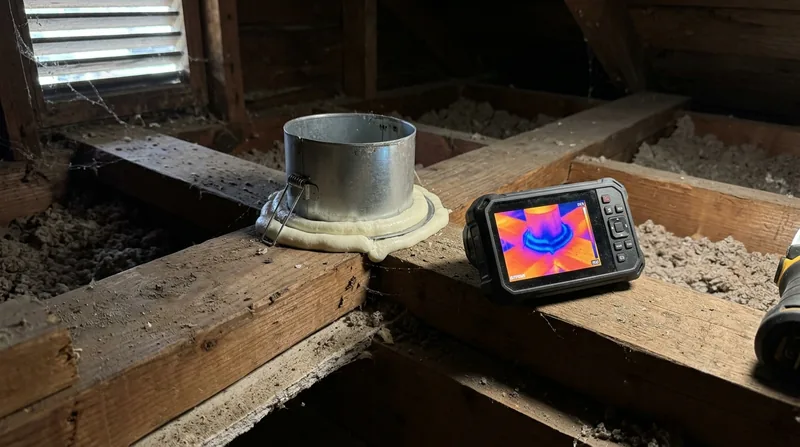




Air sealing in Fargo stops the warm air leak that builds ice dams every winter. Top plates, can lights, chimney chases and attic hatches lose more heated air than most walls do. That warm leak rises into the attic, melts snow on the roof, and refreezes at the eave as ice. Seal those penetrations before insulating, and you cut the leak at the source. It is the cheapest comfort fix in a Fargo house, and it works year-round: in summer it keeps cool air inside; in winter it stops the cycle that destroys gutters and shingles. We seal first, insulate second, and measure the work in R-value and thickness so you know what you paid for.
Why Air Sealing Matters in Fargo: The Ice Dam Problem
Fargo sits on the dead-flat floor of the Red River Valley, where attics reach 130 degrees in July and drop to 30 below in January. Every winter, warm air leaks from the living space into the attic through unsealed top plates, electrical outlets, and can light fixtures. That warm air melts the snow sitting on the roof. The meltwater runs down to the eave, where the overhang stays below freezing, and refreezes as ice. The ice dam blocks more meltwater, which backs up under the shingles and leaks into the walls and ceilings. Air sealing stops the warm leak before it ever reaches the attic.
- Seal the top plate where the attic floor meets the walls, the single largest leak point in most Fargo homes.
- Close off can light fixtures, which push warm air straight into the attic in an uninsulated cavity.
- Seal the chimney chase, where heated air rises around the flue and escapes at the roof.
- Seal the attic hatch, which often sits on an unsealed frame and leaks as much air as an open window.
- Close electrical outlets, wiring chases, and HVAC penetrations that connect the living space directly to the attic.
Sealing these points before adding insulation is the difference between a comfortable attic and a cold one that still leaks.
Key info: A 1940s cape or ranch in the Jefferson or Lewis and Clark neighborhoods often has a knee-wall attic with original fiberglass that has settled and a top plate that was never sealed. Air sealing that top plate costs a fraction of replacing the insulation, and the payoff shows up in February when the ice dams stop.
For more on how air sealing integrates with a full insulation strategy, see our attic spray foam insulation page. The North Dakota Department of Commerce publishes energy conservation guidance for homeowners, which includes air sealing as a priority measure.
How We Air Seal: The Process in Fargo Homes
We start with a walk-through of the attic to identify every penetration, leak, and unsealed junction. We photograph the work, measure the area, and give you a written estimate that specifies R-value and the thickness of foam we will apply. We schedule the work around your calendar and the weather. On the day of the job, we set up mechanical ventilation, suit up, and spray closed-cell or open-cell foam at the points we identified. Closed-cell foam (R-6 per inch) is the standard for air sealing because it cures fast, hardens to a solid seal, and is moisture-resistant. We apply the foam in passes no thicker than one inch at a time, allowing each pass to cure fully before we spray the next. Once the foam cures (typically 24 to 48 hours), we install thermal and ignition barriers if required by code, and you can re-enter the attic.
- We inspect the attic, identify every air leak, and photograph the scope so you see exactly what we are sealing.
- We provide a written estimate with R-value and thickness specified, so there is no mystery about the material or the coverage.
- We set up mechanical ventilation during the spray and cure, so fumes are exhausted outside and re-entry is safe on schedule.
- We spray in thin passes, allowing each to cure fully, so the foam reaches full strength and does not shrink or fail.
- We install thermal and ignition barriers per code, and we coordinate with your local building department if a permit is required at your address.
The whole process is clean, documented, and done by someone you can call if a question comes up later.
Example: A 1970s split-entry bi-level in south Fargo with a rim joist that was never sealed and a top plate that leaks. We seal the rim from the basement side (closed-cell, R-6, one inch thick), then move to the attic and seal the top plate and can lights. The total foam coverage is about 80 board feet. The job takes one day, and the mechanical ventilation runs for 48 hours. Cost is typically $1,200 to $1,600 for that scope. See our rim joist and band joist page for more on basement air sealing.
Air Sealing Methods and Materials
| Method | Description | Best for |
|---|---|---|
| Closed-Cell Spray Foam | High-density foam that cures to a rigid solid. R-value of R-6 per inch. Moisture-resistant and airtight. Applied in thin passes. | Top plates, rim joists, can lights, chimney chases, and any attic penetration where a permanent, hard seal is required. |
| Open-Cell Spray Foam | Lower-density foam that cures spongy. R-value of R-3.5 per inch. Vapor-permeable and flexible. Good for attic insulation when air sealing is secondary. | Attics where insulation value is the priority and moisture drive is outward (typical in Fargo winters). Not recommended for rim joists or below-grade spaces. |
| Caulk and Sealant | Polyurethane or silicone caulk for small gaps and seams. Applied by hand or caulk gun. Not structural, but airtight when cured. | Small gaps around electrical outlets, wiring chases, and trim. Often used in combination with foam to seal fine details. |
| Foam Board and Gaskets | Rigid foam board installed around can lights and attic hatches. Gaskets seal the edges. Mechanical, not sprayed. | Can light fixtures that must remain accessible and attic hatch frames where a removable seal is preferred over spray foam. |
The choice of method depends on the location, the size of the gap, and whether the seal needs to be permanent or adjustable. We assess each penetration and recommend the best approach for your attic.
Air Sealing Cost in Fargo: What to Expect
Air sealing in Fargo typically starts at $650 for a small job (a handful of can lights, one or two penetrations, minimal square footage). Most homes need $1,200 to $2,500 in air sealing work, depending on the number of penetrations, the attic size, and whether we are sealing the rim joist from the basement as well. A full attic air seal on a 1970s split-entry with a cantilever rim, a leaky top plate, and a dozen can lights can run $2,500 to $3,500. The cost is driven by the board feet of foam we apply (measured on site), the complexity of the work, and the access difficulty. A ranch with a simple attic and clear access costs less than a two-story with a complex roof line and tight spaces. We provide a written estimate before we start, so you know the total cost and the scope.
We also recommend getting 2 or 3 estimates from other contractors in Fargo and West Fargo so you can compare the material, the thickness, the R-value, and the warranty. A low-ball estimate with no R-value specified and no detail on the thickness is a red flag. We price our work fairly and stand behind it with a workmanship warranty of three years. For a full pricing overview and to see how air sealing fits into a larger spray foam project, visit our pricing page.
What to Look for When Hiring an Air Sealing Contractor Near Fargo
Hiring the right spray foam contractor is the difference between a job that solves your problem and one that creates new ones. A good contractor is fully insured, provides a written estimate with R-value and thickness specified, and is reachable after the job is done. A bad contractor shows up with no estimate, sprays foam without mechanical ventilation, promises immediate re-entry, and disappears when the smell lingers or the foam shrinks. We are fully insured and have been in business since 2012. We give you a written estimate with all the details, we follow the manufacturer's specs for temperature, ratio, and application, and we set up mechanical ventilation so the job is safe and the cure is complete. When you call other contractors, ask them for their R-value and thickness on paper, ask for references in Fargo or West Fargo, and ask whether they carry liability insurance and whether they will provide proof. Ask whether they handle permits or whether you do. Verify that the contractor is reachable by phone and that they respond within 24 hours. Call us at (701) 501-6701 for a free estimate, and contact us online if you prefer email.
Air Sealing in Fargo: Pricing Guide
| Service | Price | Details |
|---|---|---|
| Small air seal job | Starting at $650 | A handful of can lights or penetrations, minimal attic square footage, straightforward access and few obstacles |
| Typical air seal with insulation | Starting at $1,200 | Top plate, rim joist, can lights, and chimney chase sealed, plus insulation added; 40 to 80 board feet of closed-cell foam |
| Full attic air seal on split-entry or two-story | $2,500 to $3,500 | Multiple penetrations, complex roof line, cantilever rim, and tight access; 100 to 150 board feet of closed-cell foam applied in thin passes |
| Travel and setup | Included | No separate mileage or travel fee in Fargo and surrounding service areas; setup and mechanical ventilation are part of the job cost |
| Free written estimate | No obligation | R-value and thickness specified in writing, response within 24 hours at (701) 501-6701, no cost to schedule or cancel |
Indicative pricing, the exact cost depends on square footage, finish, and site access. Free personalized estimate within 24h at (701) 501-6701.


